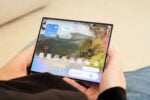

Using three apps side-by-side on the Galaxy Z Fold 8 for multitasking
TL;DR
Google will require Android apps on the Play Store to meet a baseline large-screen quality standard by April 2027 or they cannot be published or updated.
Games must meet the same baseline by August 2027, with additional screenshot, scaling, and state-preservation requirements for foldables and tablets.
Higher tiers for apps and games reward better optimization with Play Store badging, merchandising, and support for features like multi-pane layouts, controllers, and high-frame-rate rendering.
Foldable hardware has improved by leaps and bounds over the past few years, but the optimization of Android apps and games for those devices hasn't kept up. Google is now taking a major step to fix that. It will soon start forcing third-party developers to optimize their apps and games for big-screen Android devices like foldables, tablets, and computers.
When Google launched Android 12L in 2022, it encouraged third-party developers to adapt their apps and games for large-screen and foldable Android devices. However, progress has been agonizingly slow.
Apps on Google Play Store are required to be optimized for foldable phones and tablets by April 2027
Following the launch of the iPhone Duo, Google is no longer willing to wait for developers to improve their software at their own pace. The company has announced that all developers publishing apps on the Google Play Store must meet mandatory adaptive quality standards starting in April 2027.
This means developers must ensure their apps scale properly across varying screen sizes, aspect ratios, and folding mechanisms. Google has broken down its large-screen and foldable quality guidelines into three tiers:
Tier 3 (Ready)
Google
Tier 1 app guidelines for removing black bars
Properly utilizes available screen space and avoids unnecessary black bars.
Supports different screen sizes and orientations (both portrait and landscape) and functions properly in multi-window environments such as Samsung DeX.
Preserves the user's current state, including media playback, scroll positions, and text input, when the device is folded or unfolded, rotated, or when the app window is resized.
Tier 2 (Optimized)
Google
Tier 2 app layout guidelines
Intelligently adapts the UI to fit the specific screen it is running on.
Uses multi-pane layouts on large displays to make better use of the extra screen real estate rather than simply stretching a phone UI.
Tier 1 (Differentiated)
Google
Unfolded
Google
Folded
Fully embraces large-screen and foldable devices with optimized UIs for tabletop mode and book-style layouts.
Offers high-frame-rate rendering at 60FPS and 120FPS.
Supports multiple app instances running side by side.
Uses modern, efficient graphics rendering alongside dynamic resolution and UI scaling across cover and inner foldable screens.
Apps that fail to meet at least the Tier 3 standard by April 2027 will be blocked from being published or updated on the Google Play Store. Developers will not be able to submit new apps or push updates to existing ones unless their apps meet this baseline requirement.
Games must be optimized for Android foldables and tablets by August 2027
Google also announced that all games must meet at least the Tier 3 quality standard by August 2027. Specifically, game developers will be required to meet the following rules:
Mandatory foldable screenshots (starting April 2027): Developers must upload at least three dedicated foldable screenshots when submitting new games or updates, covering 1:1 and 4:3 aspect ratios for inner screens and a 16:10 aspect ratio for the outer screen.
Proper display scaling: Games must offer full-screen rendering, unobstructed HUDs (controls and game view shouldn't cut off), and proper letterboxing in unsupported orientations.
Seamless state preservation: Games must preserve their state without restarting when a device is folded or unfolded. Whether you play in portrait or landscape mode, or switch between the cover and inner displays, the game must scale appropriately without distorted UI elements or controls.
Tier 3: Ready (Mandatory Baseline by August 2027)
Full-screen rendering in the game's supported orientations.
Unobstructed HUD safe areas (ensuring controls and HUD elements aren't cut off or blocked by notches/camera cutouts).
Clean in-engine letterboxing or pillarboxing when the device is rotated to an unsupported orientation.
State and touch alignment preservation: Preserves game progress/state and keeps touch controls accurately placed across folding, unfolding, screen rotation, and multi-window resizing
High-resolution graphics tailored for larger displays
Proportional HUD scaling across foldables and tablets.
Styled visual framing: When letterboxing is applied, custom visual borders should be used instead of displaying plain black bars when an aspect ratio isn't natively filled.
Smooth frame pacing.
External input support: Support for external controllers, keyboards, and mice.
Perks/Rewards: Also unlocks foldable Play Store badging, enhanced merchandising, and sets games up for Google Play Games Level Up.
Sustained high-frame-rate performance: 60 FPS, and 120 FPS on supported displays.
Thermal and battery stability: Maintained across extended unfolded gameplay sessions
Modern graphics: Efficient modern graphics rendering.
Dynamic resolution scaling: Seamlessly adjusts between inner and cover screens.
Perks/Rewards: Unlocks foldable Play Store badging, enhanced merchandising, and helps qualify for the Google Play Games Level Up program.
Games that go further and reach Tier 1 and Tier 2 standards, such as adding support for controllers, keyboards, and mice, will receive better visibility and merchandising on the Google Play Store.
These enforcement rules will not only elevate app quality on Android foldables and tablets, but also ensure apps work seamlessly on Googlebook OS-powered laptops and computers. Ultimately, this is a welcome move that will make using Galaxy Z series foldable phones and Samsung DeX a much better experience.