Last updated: June 17th, 2026 at 14:05 UTC+02:00
SamMobile has affiliate and sponsored partnerships, we may earn a commission.
It has a 1.3-inch size.
Reading time: 2 minutes

Abhijeet Mishra / SamMobile
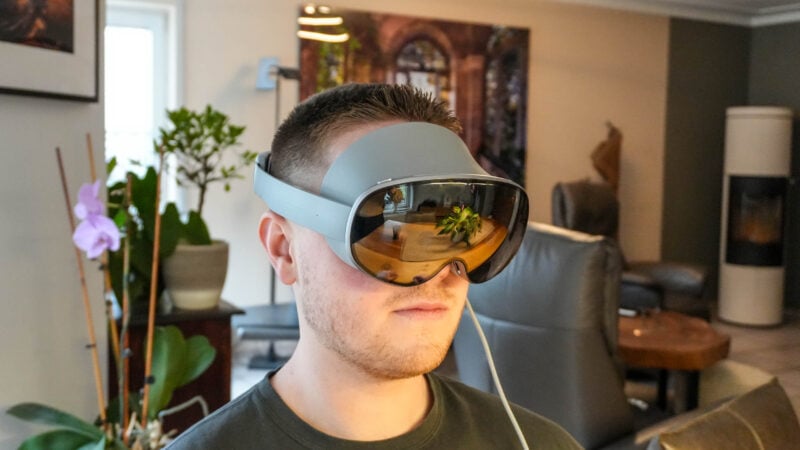
Last year at AWE USA, Samsung Display launched RGB OLEDoS displays for XR headsets that had a peak brightness of 20,000 nits. This year, the company is taking things to the next level.
At AWE USA 2026, the South Korean tech giant has unveiled an RGB OLEDoS display for XR headsets that has a jaw-dropping peak brightness of up to 40,000 nits. That’s right. Forty thousand.
This display measures 1.3 inches. Unlike traditional OLEDoS displays that use white pixels, this one features a single-panel structure that does not require a color filter. This offers higher light efficiency and a longer lifespan.
According to the company, the new screen has a high resolution, displaying fine details with exceptional sharpness while reproducing highly vivid colors—all of which are essential for immersive XR environments.

Samsung Display
Samsung Display booth at AWE USA 2026 – Source: Samsung Display
To demonstrate the 1.3-inch RGB OLEDoS screen at the exhibition, Samsung Display has set up a specialized dark room called “The Big Dipper.” This room has seven displays arranged to recreate the Big Dipper constellation. Among them, only two screens are the new RGB OLEDoS models.
The installation is designed to create a dramatic contrast in brightness within the darkened environment, allowing visitors to experience its high-luminance capabilities firsthand. Samsung may use these displays for its future XR products, and other tech companies, like Apple, may also adopt them.

Samsung Display
Samsung Display booth's The Big Dipper room at AWE USA 2026 – Source: Samsung Display
Along with that, the brand is showcasing a pair of AR smart glasses with 0.62-inch RGB OLEDoS displays, alongside an MR headset prototype featuring RGB OLEDoS to showcase immersive K-pop concert content and gameplay.
Then there’s a stretchable display that remains flat under normal conditions but physically protrudes and changes shape based on the usage environment. Lastly, we have a Light Field Display (LFD), a glasses-free, headset-free 3D display that shifts the visual perspective realistically based on where the viewer is standing.

I’m a computer science engineer living in Hyderabad, India, who has a keen interest in automobiles and consumer electronics. My journalism career kicked off in 2017 with MySmartPrice where I wrote news, features, buying guides, and explanatory articles about technology among other things, and reviewed many products, including smartphones, tablets, laptops, PC components, smartwatches, audio devices, wearables, and smart home products. Since then, I have worked for 91Mobiles, Apple, and Onsitego, before finally landing on SamMobile.