Last updated: July 27th, 2026 at 07:31 UTC+02:00
SamMobile has affiliate and sponsored partnerships, we may earn a commission.
While both are book-style foldables, they're designed to deliver very different experiences.
Reading time: 6 minutes

Max Jambor / SamMobile
Samsung's Galaxy Z Fold 8 series gives you two very different book-style foldables. While they share the same basic concept, they're designed to deliver very different experiences.
If you're trying to decide which one to buy, the answer isn't simply about comparing specifications. Instead, it comes down to how you want to use a foldable.

Max Jambor / SamMobile
Galaxy Z Fold 8 and Fold 8 Ultra – Source: Max Jambor / SamMobile
Although both phones are book-style foldables, they sit at opposite ends of the spectrum when it comes to their design.
The Galaxy Z Fold 8 Ultra follows what has become the conventional book-style foldable formula. Samsung helped establish this design years ago, and it remains familiar today.
You get a traditional smartphone on the front with a tall 21:9 cover display that unfolds into a large inner screen with a square-like aspect ratio. That inner display gives you plenty of room for consuming content, multitasking, and productivity.

Max Jambor / SamMobile
Samsung Galaxy Z Fold 8 Ultra – Source: Max Jambor / SamMobile

Max Jambor / SamMobile
Samsung Galaxy Z Fold 8 Ultra – Source: Max Jambor / SamMobile

Abhijeet Mishra / SamMobile
Instagram on Galaxy Z Fold 8 Ultra – Source: Abhijeet Mishra / SamMobile

Max Jambor / SamMobile
Galaxy Z Fold 8 Ultra running YouTube – Source: Max Jambor / SamMobile
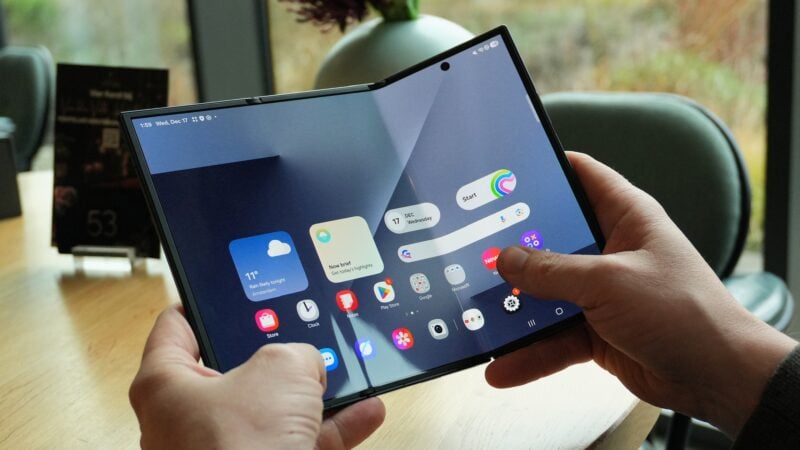
The Galaxy Z Fold 8 follows the same concept but executes it very differently. Its 5.5-inch cover display uses a much shorter 16:10 aspect ratio, making the phone feel compact and comfortable to hold in one hand.
Once you unfold it, the experience changes again. The Fold 8 uses a 4:3 inner display that feels wider. You can also rotate the display into portrait orientation to create a taller workspace.
That gives you the flexibility to use the phone either as an entertainment device or for productivity, depending on what you're doing.

Max Jambor / SamMobile
Samsung Galaxy Z Fold 8 – Source: Max Jambor / SamMobile

Max Jambor / SamMobile
Galaxy Z Fold 8 split-screen multitasking – Source: Max Jambor / SamMobile

Max Jambor / SamMobile
Video playback on Galaxy Z Fold 8 cover screen – Source: Max Jambor / SamMobile

Max Jambor / SamMobile
Samsung Galaxy Z Fold 8 – Source: Max Jambor / SamMobile
Ultimately, the biggest question is how you want to use a foldable.
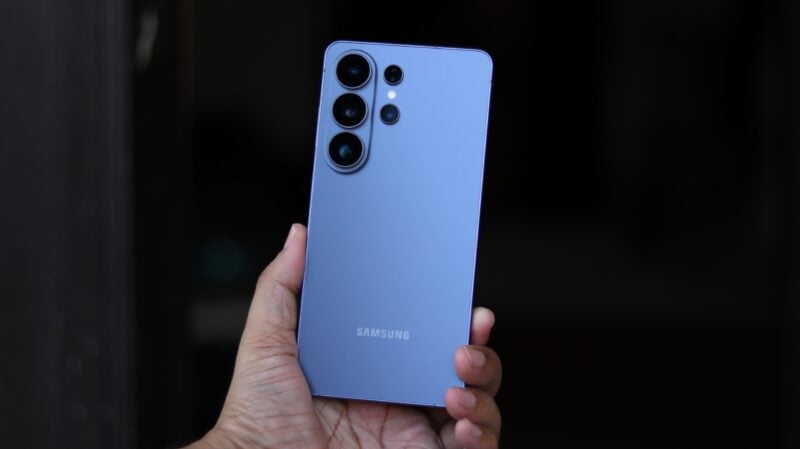
If you want something that behaves like the biggest version of a conventional smartphone, the Fold 8 Ultra is designed to deliver exactly that. It's taller than it is wide, and even its camera layout reinforces that familiar feel. The goal is to make the move from a traditional smartphone to a foldable feel as natural as possible.
The Fold 8 asks you to think differently. Rather than simply replacing your existing smartphone with a larger version of itself, you'll need to adjust to an entirely different form factor. It's a different mindset, much like the adjustment people made when moving to flip phones years ago.

Max Jambor / SamMobile
Galaxy Z Fold 8 and Fold 8 Ultra – Source: Max Jambor / SamMobile
The differences continue with the cameras. The Galaxy Z Fold 8 Ultra features a 50MP ultra-wide camera, a 200MP primary camera carried over from the Fold 7, and a 10MP 3x telephoto camera.
The Fold 8 also includes the same 50MP ultra-wide camera, but pairs it with a 50MP primary camera and doesn't include a dedicated telephoto lens, so you're restricted to digital zoom.
The differences aren't limited to the hardware, though.
The Fold 8 Ultra continues to support Flex Mode, allowing you to prop the phone up on a flat surface and use it almost like a tripod. Samsung's software has been built around that capability.
The Fold 8 doesn't offer the same experience because its hinge isn't designed to stay open securely at multiple angles. At a certain point it simply wants to open flat, and while it may remain partially open for a moment, it isn't stable enough for Samsung to build Flex Mode around it.
If you regularly capture photos or videos hands-free, that alone may be enough reason to choose the Fold 8 Ultra. The Fold 8 Ultra also supports Samsung's APV codec. Videos recorded using the APV codec have a higher bitrate and retain much more information than a standard video even after multipe rounds of editing.

Max Jambor / SamMobile
Samsung Galaxy Z Fold 8 Ultra rear cam selfie – Source: Max Jambor / SamMobile
The Fold 8 still has its own advantages. Both the cover display and the inner display can give you a large preview while using the rear cameras. Just keep in mind that the camera orientation changes depending on which display you're using. One orientation captures portrait content, while the other captures landscape because of the way the cameras are positioned.
When it comes to performance, there isn't much separating the two devices.
The Fold 8 includes a 4,800mAh battery, while the Fold 8 Ultra increases capacity to 5,000mAh. However, because the Ultra also has larger displays, that extra battery capacity may simply offset the additional power consumption.

Max Jambor / SamMobile
Galaxy Z Fold 8 Ultra battery info – Source: Max Jambor / SamMobile

Max Jambor / SamMobile
Galaxy Z Fold 8 battery info – Source: Max Jambor / SamMobile
Both phones use silicon-carbon batteries, support 45W super fast charging and 20W wireless charging, and are powered by the Snapdragon 8 Elite Gen 5 for Galaxy processor with up to 16GB RAM and 1TB of storage. So you can expect essentially the same performance from both phones.
The biggest software differences come from the two phones' different form factors.
Max Jambor / SamMobile
Galaxy Z Fold 8 split-screen multitasking – Source: Max Jambor / SamMobile
The Fold 8's wider display gives you some multitasking advantages: you can comfortably run three apps side by side.
The Ultra model also supports three apps at once, but it uses Samsung's more traditional layout, with one app taking up half the screen while the other two share the remaining half.

Abhijeet Mishra / SamMobile
Galaxy Z Fold 8 Ultra split-screen multitasking – Source: Abhijeet Mishra / SamMobile
The Fold 8's wider aspect ratio also gives split-screen apps more usable space. Instead of having two tall, narrow app windows, you get two wider ones, which may be more practical depending on what you're doing.
Both approaches work well, and your preference will ultimately depend on how you like to multitask.
Samsung has positioned the Fold 8 as the more affordable entry point into its foldable lineup, even though it's still a premium smartphone with high-end engineering and build quality.
The Fold 8 Ultra now costs more than $2,000 in the US. However, Samsung's promise of seven generations of Android OS upgrades may make that investment easier to justify if you plan to keep the phone for a long time.
Ultimately, you'll have to decide how much value you place on the Ultra's additional features and whether they're worth the higher price. If a more visible crease doesn't bother you, last year's Galaxy Z Fold 7 also remains a compelling option.
Whichever phone you choose, you'll get excellent performance, good cameras, and strong video capabilities. The real question is what kind of experience you're looking for.
If you want something fun and different, the Fold 8 delivers exactly that. If you'd rather have something sleek, polished, and refined, that's what the Fold 8 Ultra is designed to offer.

First Samsung device: SGH-D500
Abhijeet's writing career started with guides for custom firmware for Samsung devices (including the original Galaxy S), and he moved to SamMobile in mid-2013 and worked up the ranks to Editor-in-chief. In addition to phones and mobile devices, his interests include gaming on both PC and console, PC hardware, and spending countless hours on YouTube watching videos on tech, movies, games, politics, and internet dramas.